Media Summary: Without doing any optics yet, here we think about what is required to make an Following from our description of diffraction through an aperture with H-F wavelets, you can think of an object to be imaged as a ... We start by calculating the shape of a dielectric that will create a perfect
Phys 201 Image Formation By - Detailed Analysis & Overview
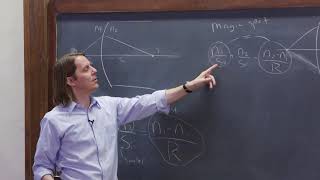
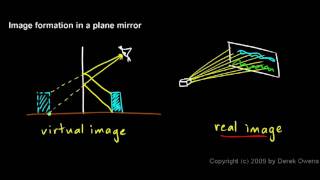
Without doing any optics yet, here we think about what is required to make an Following from our description of diffraction through an aperture with H-F wavelets, you can think of an object to be imaged as a ... We start by calculating the shape of a dielectric that will create a perfect Something special happens if the object is too close - you don't get a real When you calculate the diffraction patter of the object, it is a Fourier transform of the object. Here we trace rays through the sphere and find the "magic point" that yields straight rays. -----Geometrical Optics playlist ...
For the thin spherical lens, we can derive the Lensmaker's Equation which gives the focal length in terms of the lens radii and ... Glass hyperboloids are nice, but it is much easier to grind glass into a sphere, so here we calculate the optical properties of a ... So how do we use ray diagrams to figure out where an Here we specify the thin lens equation, magnification, and how to trace the 3 Easy Rays -----Geometrical Optics playlist ... Serway and Jewett, 10th Edition, Chapter 35, Section 5. As an introduction to Geometrical Optics, we state the two laws that it all depends on: Reflection and Refraction. We will justify ...